
Tae Kwon Do and Mindfulness in a DBT-IOP
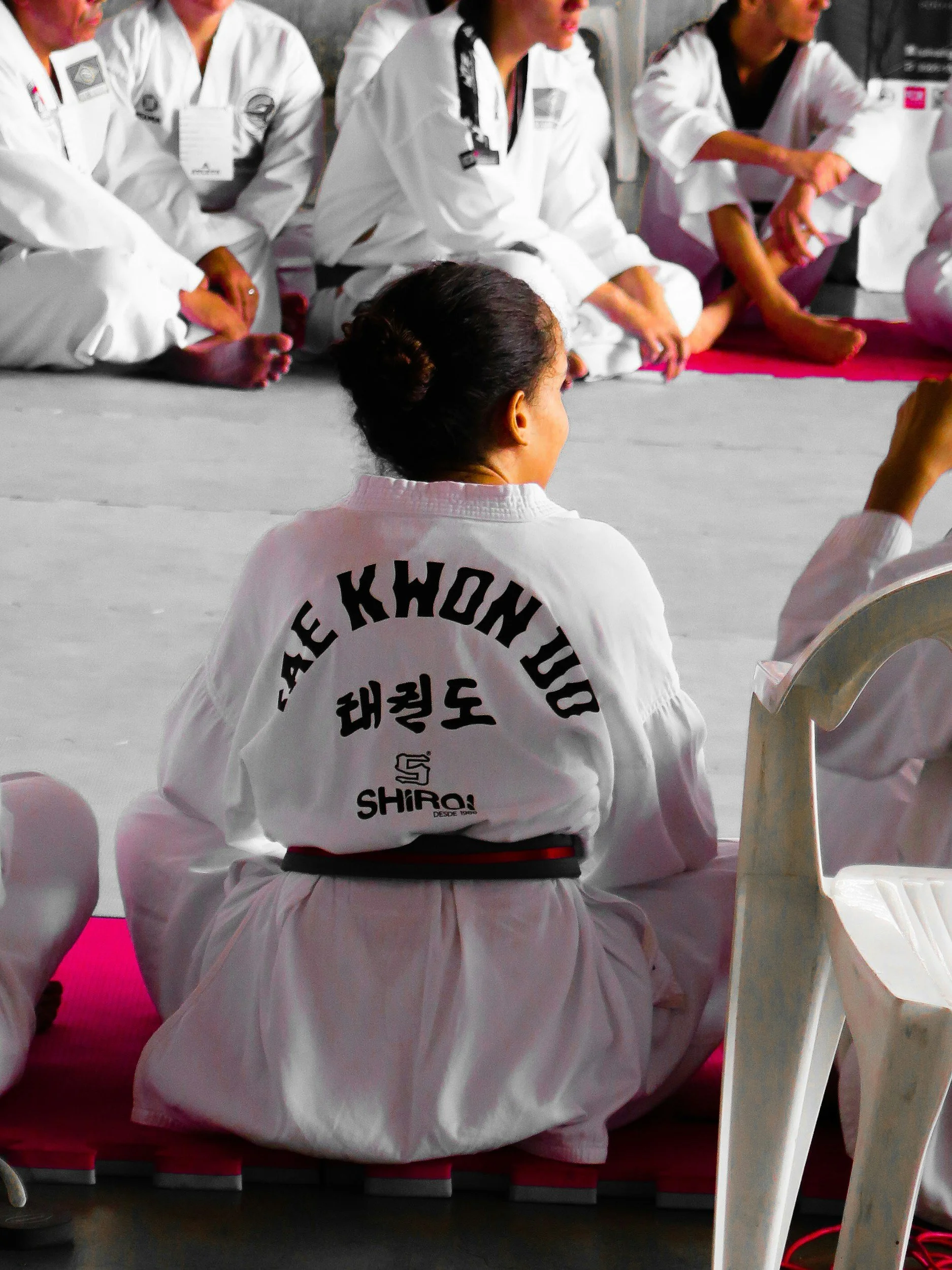
A promising candidate for a mindful movement intervention is Taekwondo (TKD). TKD is Korean martial art that emphasizes connections between mind and body; central to TKD instruction and practice are tenants of psychological fulfillment including self-respect and perseverance (Park & Gerrard, 2000). TKD is practiced in over 200 countries (European Taekwondo Union, 2024), and core philosophies are likely ubiquitous across cultures. For instance, qualitative work from the United States has demonstrated that TKD is a cross-cultural activity that enhances personal growth (Kim et al., 2014). The mind–body integration inherent to TKD and other forms of martial arts positions them as especially effective mindful movement interventions and distinguishes them from other forms of physical exercise (Naves-Bittencourt et al., 2015). Studies have demonstrated connections between increased mindfulness and martial arts engagement (Lothes et al., 2013). Relatedly, theoretical research has highlighted parallels between group psychotherapy and martial arts training, including positive social interactions, group cohesion toward overcoming obstacles, and shared goals of growth and change (Weiser et al., 1995).
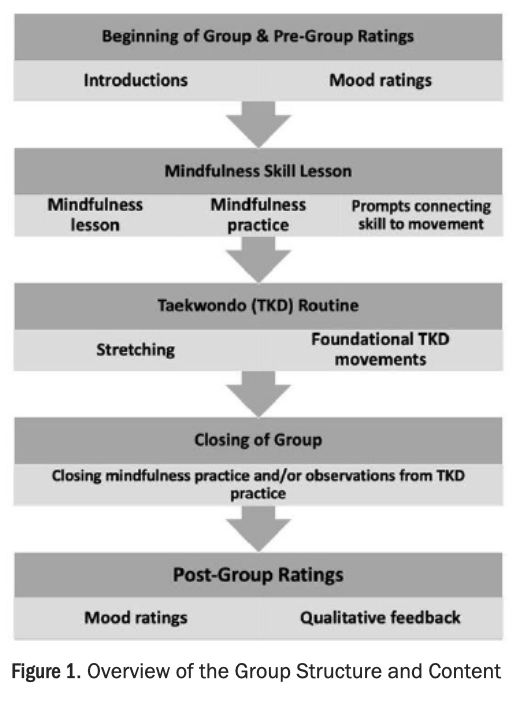
Studies examining TKD specifically have shown associations between TKD engagement and psychological benefits including increased self-esteem, positive body image perceptions (Weiss & Miller, 2019), stress management (Petrovic, 2017), and positive affect (Toskovic, 2001). TKD can also be modified to accommodate individuals with physical limitations, does not require external equipment (Weiss et al., 2024), and can be taught to staff without extensive background training (Calinog et al., 2021). Recently, we demonstrated the acceptability and feasibility of a TKD and mindfulness pilot intervention for adults on an inpatient mood disorders unit. Participants reported significant decreases in anxiety following engagement in a group combining DBT-based mindfulness skills and TKD practice (Weiss et al., 2024). Together, these findings add to the extensive literature on the benefits of exercise interventions for clinical populations, and suggest that TKD may be a viable, yet relatively unexplored, avenue for mindful movement interventions.
In the present study, we seek to examine feedback regarding patient experience in a mindfulness skills group incorporating a TKD practice (TKD and Mindfulness Group), we aimed to examine whether group engagement resulted in changes in affective states. We hypothesize that patients would report decreases in negative affect (sadness, anxiety), and increases in positive affect (happiness, relaxation) following engagement in the TKD and Mindfulness Group. Additionally, we hope to determine whether decreases in negative affect and increases in positive affect were greater for TKD and Mindfulness Groups relative to Mindfulness Groups (Comparison Groups) alone. Finally, given the high comorbidity between BPD and eating disorders (Newton, 2019; Zanarini et al., 1998), increased complexity and severity of this comorbid presentation (Chen et al., 2009), and benefits of exercise interventions for individuals with eating disorders (Cook et al., 2016), we plan to conduct exploratory analyses examining whether the TKD and Mindfulness Group result in greater changes in affect for individuals with eating disorder symptoms.
Suggested reading:
Citations:
Park Y.H., Gerrard J.: Black Belt Taekwondo: The Ultimate Reference Guide to the World’s Most Popular Black Belt Martial Art . 2000 . Checkmark Books ,
European Taekwondo Union. (2024). Origin of Taekwondo . Retrieved 02/11 from https://europetaekwondo.org/taekwondo/#:∼:text=Today%2C%20taekwondo%20is%20practiced%20by,the%20world's%20most%20popular%20sports.
Kim J., Heo J., King C., Kim S.: Cultural understanding and personal growth through Taekwondo as cross-cultural activity . 2014; 54 (3): pp. 356-376.
Naves-Bittencourt W., Mendonça-de-Sousa A., Stults-Kolehmainen M., Fontes E., Córdova C., Demarzo M., Boullosa D.: Martial arts: Mindful exercise to combat stress . 2015; 34: pp. 34-51.
Lothes J., Hakan R., Kassab K.: Aikido experience and its relation to mindfulness: A two-part study . 2013; 116 (1): pp. 30-39.
Weiser M., Kutz I., Kutz S.J., Weiser D.: Psychotherapeutic aspects of the martial arts . 1995; 49 (1): pp. 118-127.
Weiss E.R., Miller J.G.: Training the body and mind: Examining psychological correlates of Taekwondo . 2019; 5: pp. 1-17.
Petrovic K.: The benefits of Taekwondo training for undergraduate students: A phenomenological study . 2017; 7 (3):
Toskovic N.N.: Alterations in selected measures of mood with a single bout of dynamic Taekwondo exercise in college-age students . 2001; 92: pp. 1031-1038.
Weiss E.R., Hart-Derrick V.R., Brodie J., Davis M.T.: Mind-body connections: Results from a pilot study of Taekwondo and mindfulness for adults on an inpatient psychiatric unit . 2024; 47 (3): pp. 149-156.
Calinog M., Kugel J.D., Krpalek D., Salamat A.: The feasibility of Taekwondo for addressing social interaction and social participation in Children . 2021; 9 (2): pp. 1-13.
Newton J.R.: Borderline personality disorder and eating disorders: A trans-diagnostic approach to unravelling diagnostic complexity . Australasian Psychiatry 2019; 27 (6): pp. 556-558.
Zanarini M.C., Frankenburg F.R., Dubo E.D., Sickel A.E., Trikha A., Levin A., Reynolds V.: Axis I comorbidity of borderline personality disorder . 1998; 155 (12): pp. 1733-1739.
Chen E.Y., Brown M.Z., Harned M.S., Linehan M.M.: A comparison of borderline personality disorder with and without eating disorders . 2009; 170 (1): pp. 86-90.
Cook B.J., Wonderlich S.A., Mitchell J.E., Thompson R., Sherman R., McCallum K.: Exercise in eating disorders treatment: Systematic review and proposal of guidelines . 2016; 48 (7): pp. 1408-1414.
This study is possible due to support from the NIMH and National Institute on Drug Abuse (NIDA)